Brianna Johns, Fulbright Student Researcher at Digital Naturalism Laboratories & NSF SEEKCommons Fellow
The first time I heard about the commons was in a university course on wildlife management. During one of our lectures, were shown a series of square plots, each one representing a shared pasture with cattle. The number of cattle in each plot grew from left to right, increasing the grazing pressure within the pasture. Below the plots was a caption explaining how pasture quality decreases in response to overuse by cattle owners. The point was that if the cattle owners had unrestricted access to the commons (represented by the pasture), the commons would inevitably fail because individuals would act in their own self-interest. We were being introduced to the “Tragedy of the Commons.”
The phrase is a mainstay of popular science, a metaphor originating from an essay of the same name by Garrett Hardin. The essay follows a line of thought that (human) overpopulation is sending our planet towards an environmental tipping point, and can only be avoided through immediate intervention (or regulation). The essay was Hardin’s seminal work and is frequently discussed and debated in both economics and ecology for his view of population control as a moral imperative, as he so bluntly puts it: “Freedom to breed will bring ruin to all.” (p. 35) Ideas such as the “Tragedy of the Commons” have unfortunately gone hand in hand with unethical wildlife conservation methods, such as fortress conservation, where conservationists displace Indigenous and local communities through the creation of protected areas.
However, tragedy is not inherent to the commons. Elinor Ostrom won a Nobel Prize for demonstrating how humans can collectively govern resources outside the market and the state as part of the commons. Today, books such as Robin Wall Kimmerer’s The Serviceberry bring stories of gift-giving and the commons to the fore of popular culture, in stark contrast to Hardin’s presupposed ruin. The commons reflect not only publicly accessible resources but also the practice of self-governing and managing resources by and for those who use them.

Photo of cattle being herded from a ranch on the Azuero Peninsula of Panama. Photo credit: Bri Johns
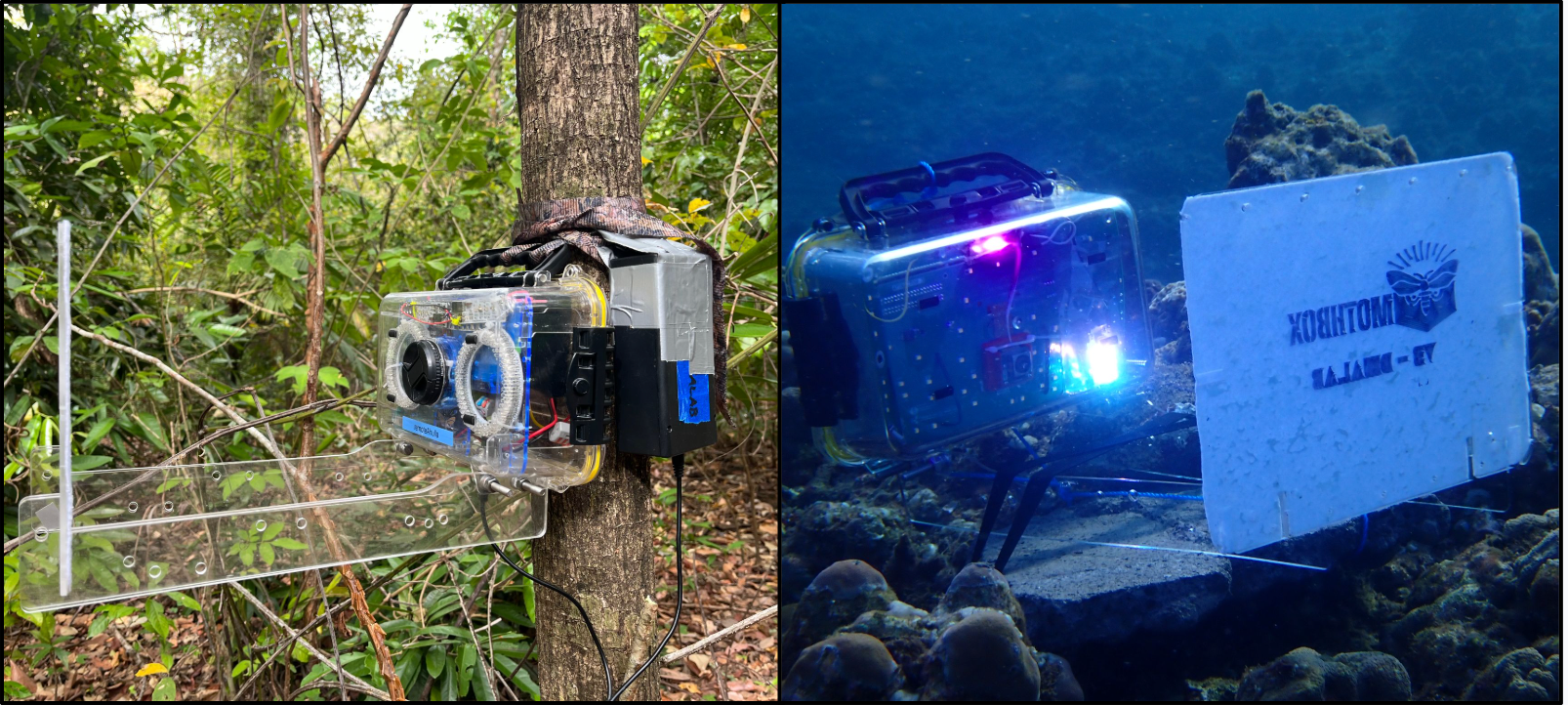
For the past year, I’ve been chasing the Mothbox from the tropical forests of Panama to the coral reefs of Bali, Indonesia, and studying the commons along the way. I’ve explored how conservation technologies are more than just tools – they are reflections of lived experiences, relationships, and values. They are objects with technical components, as well as social and ecological ones. Printed circuit boards, batteries, cameras, and regulators circulate alongside the less tangible – open source licenses, customs and norms for sharing, and scientific data, all of which are constantly redefining one another. In my travels with the Mothbox, I learned how open source conservation technologies are sold on the market and shared as gifts, and watched as they traverse multiple realms by bridging ecology and hacking. Amid these varied social practices, I witnessed how projects such as the Mothbox continue to affirm their existence as community-controlled technologies.
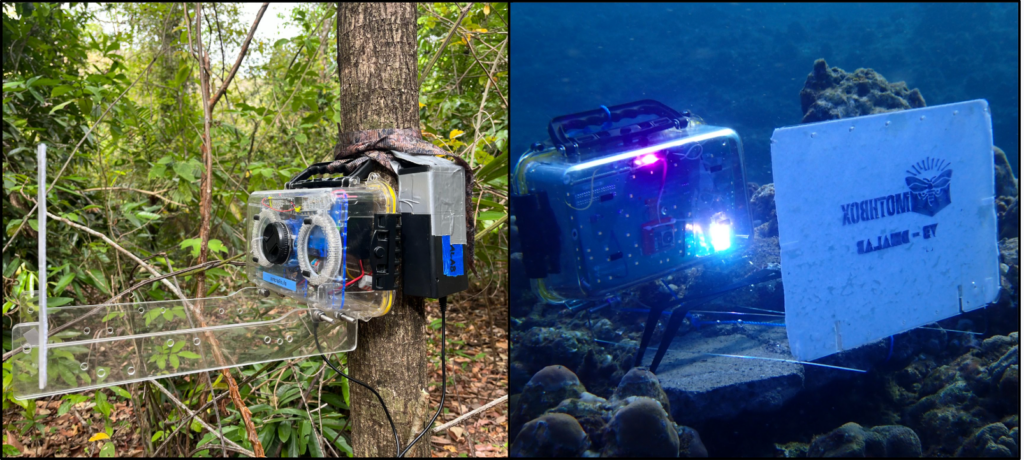
Photo of Mothboxes being deployed in the Azuero Peninsula of Panama (left) and in the coral reefs of northeastern Bali (right). Photo credits: Bri Johns and Paula Te
In October of 2024, I joined the Digital Naturalism Laboratories team as a visiting Fulbright student researcher studying the social dimensions of open technologies. While I was there, I was fortunate to receive a fellowship from the U.S. National Science Foundation’s Socio-Environmental Knowledge Commons (SEEKCommons) project, which supports Science and Technology Studies (STS) approaches to studying open science and environmental research networks. Grounded in STS theory, I analysed the Mothbox as a set of human, technological, and ecological relationships, and uncovered a fascinating web of social relationships.
I followed the Mothbox as a technician as it travelled across the globe, examining how its use and development changed over time. I interviewed hobbyist hardware tinkerers, software and hardware engineers, community organisers and ecologists, all of whom contributed time, resources, and knowledge to the project. I deployed Mothboxes alongside field biologists on the Azuero Peninsula in Panama to collect biodiversity data, and at the fourth Digital Naturalism Conference (Dinacon) in Bali, Indonesia. Through these ethnographic accounts, I began piecing together the social conditions that give rise to open source conservation technologies such as the Mothbox.
The Mothbox is a nocturnal insect monitor developed for scalable use in remote environments. It is a conservation technology grounded in Digital Naturalism practices, meaning that rather than being built in a controlled environment far away from the field, the device was designed and tested in the field with biologists who will use it. The Mothbox is also certified open source hardware. Open source hardware refers to hardware whose design is free (publicly available) for anyone to use, modify, distribute and/or sell, an extension of foundational principles as open source software.
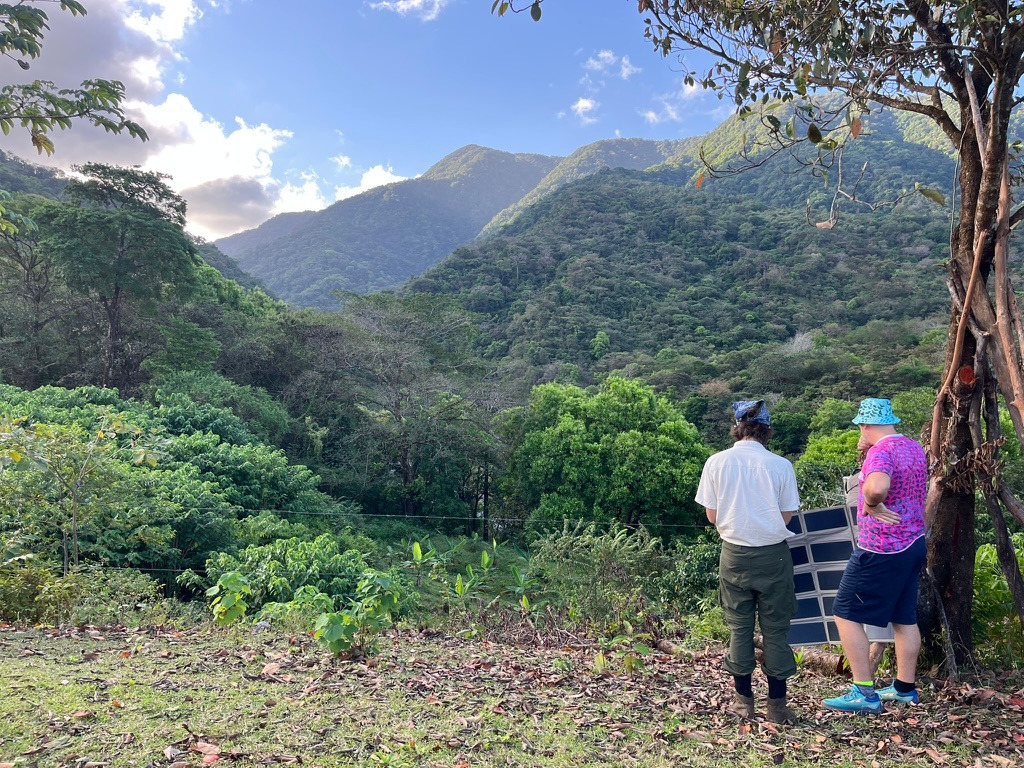
Photo from the 2025 Mothbox expedition in Cerro Hoya National Park, Panama. Photo credit: Bri Johns
Open source hardware networks have longstanding associations with the hacker movement, and cultural legacies of hacking, notably expectations for sharing and documenting tools, knowledge and skills, are alive and well in the Mothbox network. These customs and norms surrounding the “open” exchange of goods and services collided with observational practices in ecological research that prioritise collecting biodiversity data across vast spatiotemporal scales. In other words, ecologists want a tool that can collect insect data from places they couldn’t reach with existing technologies, so they worked with technologists to design a modular, easy-to-deploy device for remote field conditions. Thus, in the case of the Mothbox project, a fast-paced “do-ocratic” hacker culture that prioritises sharing and getting things done, facilitated by an accessible open source design, meshed perfectly with the research practices of ecologists and field biologists. Collectively, these social practices guide the governance of resources (knowledge, skills and objects) in the Mothbox network.

Mothbox V5 printed circuit board housed in a 3d printed enclosure. Photo credit: Digital Naturalism Laboratories
Software developers and tinkerers volunteer their time to the project, developing new software programs and printed circuit boards. Mothboxes were given to a local nonprofit in Bali, Indonesia, at the end of Dinacon, with the expectation that they would collect data for the project. These are all examples of gift-giving in the Mothbox network, where the exchange of a resource is centred around social relationships rather than a commodity that severs any chance for social connection. However, the market is inevitable when you are dealing with open science hardware – components will be bought in online stores, and sometimes the devices themselves are sold as products to research labs. The Mothbox, then, is neither a gift nor a commodity. Instead, it is a community-controlled technology that is trying to exist in a world with both. Given these circumstances, members of the Mothbox network share resources on their own terms (and within their own culture), sustaining the commons.
Open conservation technologies offer an opportunity to understand how we build, use, and ultimately govern tools for wildlife and ecological research, and can serve as a useful lens for analysing power in conservation projects (i.e., who is included in technological networks and who is not). Conservationists are currently living through a technological Zeitgeist, with remote sensing, large-scale ecological modelling, and AI-facilitated species identification software becoming increasingly common (and often criticised). However, this is not the first time humans have had to contend seriously with emerging technologies. When we examine technologies as social ecosystems and seek to understand their intricate webs of organisms, cyborgs, and more, we become better equipped to manage the technologies of our time.